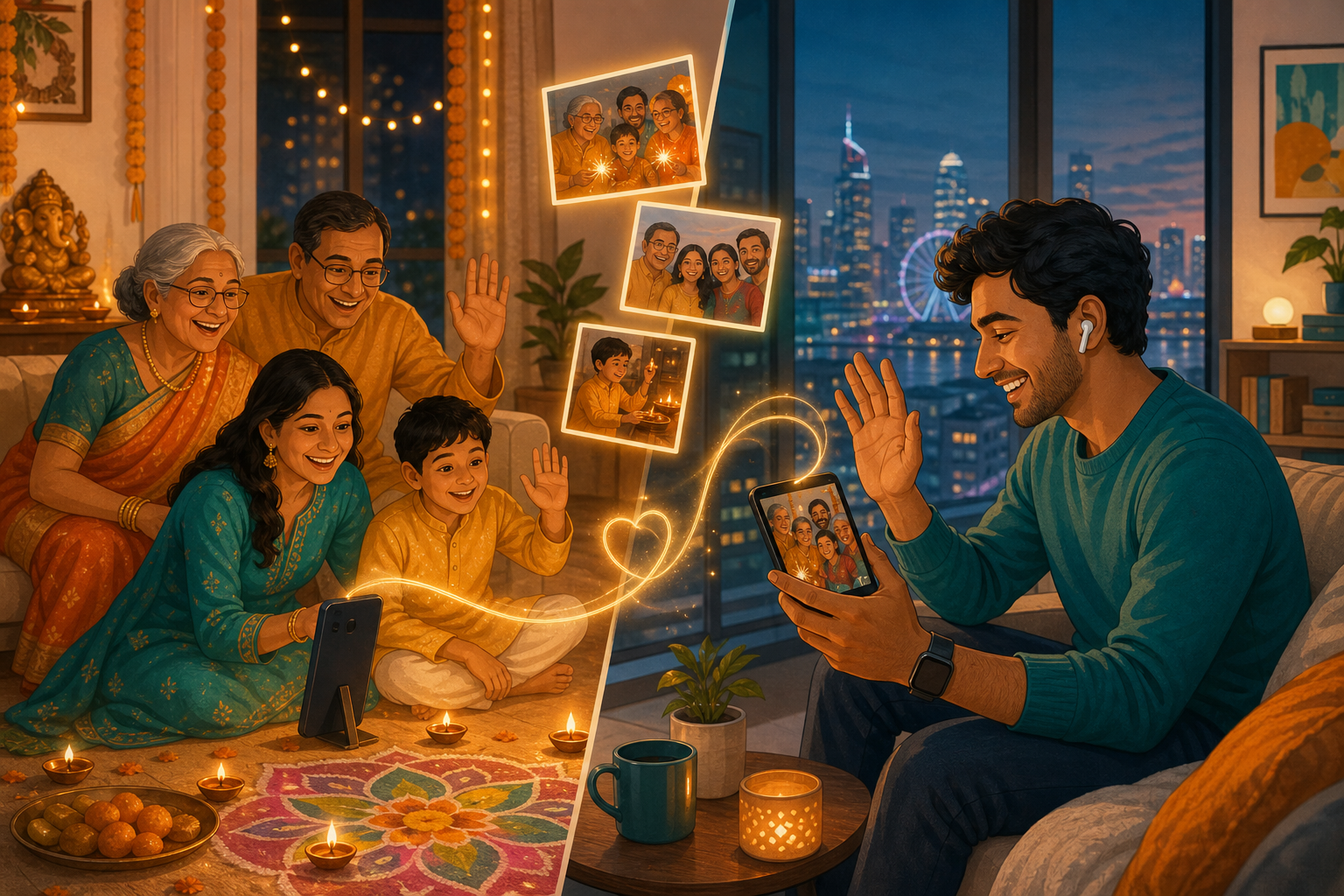
The diaspora pain points WhatsApp never solved for NRI families
The Indian diaspora is one of the world's largest - millions in the US, UK, Canada, Gulf, and Australia maintaining deep ties home. Photos are the primary thread. Yet the tools were never designed for twelve-hour lag, intermittent elder tech literacy, or the emotional weight of missing a parent's aging face between annual visits.
WhatsApp groups become performance spaces: you post a curated highlight reel, relatives react with emojis, then the image sinks beneath hundreds of messages. Quality drops with every forward. Parents feel guilty asking for more updates; you feel guilty not calling enough. Neither side gets the ambient daily awareness that living in the same city provides.
NRI family photo sharing needs permanence, quality, and simplicity for elders. Memoria's Circles recreate the feeling of flipping through a family album together - except one side is in Texas and the other in Tamil Nadu, and nobody needs to stay awake until 2 AM for a video chat.
Time zones, voice notes, and asynchronous closeness
Real-time connection across continents is a luxury working parents rarely have. Your child's bedtime is your father's lunch hour. Scheduling weekly video calls becomes another obligation on both sides, often skipped when life gets busy - which makes absence feel worse, not better.
Asynchronous NRI family photo sharing fixes this. You upload three photos from the park after school. Your parents in Ahmedabad see them with morning chai. They tap a heart. You see the heart at dinner. A thirty-second voice note from papa saying he recognized the sweater he sent replaces a guilt-inducing missed call.
Memoria voice notes attach to specific photos, so context is never lost. "This is the sweater you mailed for Diwali" lands with the image, not as a disconnected voice message in a chat scroll. For diaspora families, small daily signals often matter more than monthly hour-long calls.
Elders in India: simple enough for parents, rich enough for memories
The biggest failure mode in diaspora photo tools is assuming parents abroad and parents in India have the same tech comfort. You live in Slack and Notion; your mother in Kochi uses WhatsApp and maybe YouTube. Asking her to navigate Google Photos shared albums or Instagram close friends lists fails within a week.
Memoria's elder view is intentionally minimal: chronological photos, large tap targets, heart reaction, optional upload. You create the Circle from the US, upload the first batch of grandchild photos, and send the invite on the family WhatsApp group she already checks daily. One tap to join. Photos arrive automatically after that.
During your next India trip, help her digitize old albums into the same Circle. Her wedding photos from 1978 sit beside your son's 2026 mundan. NRI family photo sharing becomes bidirectional history, not a one-way feed of grandchildren updates to passive viewers.
Festival photos that both continents can celebrate
Diwali in New Jersey and Diwali in Jaipur should live in the same family story. WhatsApp makes this messy: US relatives post at night, India relatives post twelve hours later, forwards fill the gaps, and nobody can find the diya photo from three years ago.
Memoria Events create a dedicated album per festival inside your Family Circle. Upload your children's diyas and your cousin's rangoli from Bangalore into one Diwali 2026 Event. AI organizes faces and dates. Hinglish search finds "Diwali with dadi" instantly next year when you make the holiday card.
Festival NRI family photo sharing is emotionally charged - missing home, recreating rituals abroad, guilt about parents aging alone. A beautiful shared archive reduces that friction. Parents see you still light lamps. You see their pooja thali and feel connected without another redeye flight.
Why WhatsApp forwards are the wrong archive for diaspora memories
Indian WhatsApp culture includes forwards: jokes, political memes, chain messages, compressed videos. Family photo groups inevitably mix sacred and spam. Your daughter's arangetram photo sits between a fake health advisory and a wedding invitation from someone else's cousin.
Forwards also strip metadata and quality. Screenshots of screenshots. Videos that won't play on older phones parents use. When NRI relatives try to save important images, they discover multiple versions and no clear original.
Memoria separates communication from preservation. WhatsApp remains where you coordinate plane tickets and share the Circle link. Memoria holds the photos worth keeping at full resolution. Read our Memoria vs WhatsApp comparison for the detailed quality and privacy breakdown diaspora families should understand.
Honest look at Parivar, Family Grid, and Memoria for NRIs
Diaspora families often try Parivar or Family Grid when searching for "Indian family app abroad." Both aim at connecting relatives across countries, sometimes with family-tree visualization. If genealogy charts and branch management are your priority, explore those apps honestly.
Memoria optimizes for daily Social Memory instead: photo timelines, Events, voice notes, reactions, and AI that understands Indian festivals and Hinglish queries. No ads on the free tier. 10,000+ memories free rather than unlimited compressed storage. India-hosted data under DPDP rather than unclear residency.
There is no single winner for every NRI household. A family with fifty cousins documenting a village lineage may love tree-first apps. A nuclear family in Seattle with aging parents in Pune usually needs dead-simple photo sharing more than genealogy dashboards. Memoria is built for the second case - and scales when joint family complexity grows.
India servers, DPDP, and why data location matters for your family
When children's faces and elders' medical moments live in photos, data residency stops being abstract policy. India's Digital Personal Data Protection Act establishes expectations for consent, purpose limitation, and cross-border transfer. Families increasingly ask where their memories physically sit.
Memoria stores encrypted data on AWS Mumbai infrastructure. We do not monetize your family timeline with ads. We do not train public models on your Diwali albums. For NRI families who want parents' data processed in India while children abroad upload freely, this alignment matters.
Privacy does not mean isolation from relatives overseas. Invitation-only Circles let you include siblings in London, cousins in Dubai, and parents in Indore in the same archive with clear membership control. Remove access if needed. Export your library. Your NRI family photo sharing stays yours.
Setting up Memoria for parents in India from abroad
Step one: download Memoria on Google Play or the App Store. Step two: create a Family Circle named something your parents recognize - "Sharma Family" not "Circle 7." Step three: upload twenty recent photos - grandchildren, your home, a festival, a mundane Tuesday walk.
Step four: copy the invite link and paste it in your existing WhatsApp family group with a short voice note in Hindi or English explaining "tap this to see all photos big and clear." Step five: during your next video call, ask mom to open it and heart one photo so she knows she succeeded.
Step six: create Events before the next festival so everyone knows where to upload. NRI family photo sharing fails when setup is complicated; it succeeds when the first experience feels magical. Memoria is free to start with 10,000+ memories - no credit card, no ads. Build the bridge before the next holiday guilt sets in.
Over time, add siblings abroad and cousins in other cities to the same Circle. The archive becomes the one place everyone checks before booking flights home - seeing how parents look this month, which cousin had a baby, whether the old house's mango tree flowered again. That ambient awareness is what diaspora families lose first when photos stay trapped in chat apps.
Once the Circle has Events, Memoria AI can search across time zones in Hinglish. How that assistant gets more yours: how Memoria AI gets personal. Trust notes: Memoria AI privacy.
Frequently asked questions
What is the best app for NRI family photo sharing with relatives in India?
Memoria is built for NRI family photo sharing: private Circles with India-hosted storage under DPDP, full-resolution photos, Events for festivals, voice notes elders can play easily, and Hinglish search. WhatsApp works for quick pings but compresses and loses photos. Parivar and Family Grid are alternatives some diaspora families try, with different tradeoffs on ads, storage, and India localization.
How do I share festival photos with parents in India from abroad?
Create a Family Circle on Memoria, invite parents via WhatsApp link, and add a Diwali or Holi Event. Upload photos in full resolution from the US, UK, or Gulf. Parents in India see them in a simple timeline when they wake up - no scrolling through mixed forwards.
Does Memoria work across time zones for NRI families?
Yes. Photos upload asynchronously. When you share Thanksgiving or a school play at 8 PM in California, your parents in Hyderabad see it at breakfast. Voice notes let you record messages they play without scheduling a video call across twelve-hour gaps.
Is Memoria data stored in India for DPDP compliance?
Yes. Memoria uses encrypted servers in India (AWS Mumbai). For families who want children's and elders' photos processed under India's Digital Personal Data Protection framework, this matters more than storing on US-only platforms.
Can my parents in India use Memoria if they are not tech-savvy?
Memoria is designed for ages 8 to 80. Parents see a large-photo timeline, heart reactions, and voice notes with minimal taps. You set up the Circle from abroad and send one invite link on WhatsApp. Most elders need help only once.
How does NRI family photo sharing on Memoria compare to WhatsApp?
WhatsApp compresses quality, mixes photos with forwards, and loses media on phone changes. Memoria keeps originals in organized Circles and Events. Keep WhatsApp for daily chat; use Memoria for the photos you want in twenty years.
What about Parivar or Family Grid for NRI families?
Parivar and Family Grid target Indian diaspora with family-tree style sharing. They can work for relatives who want genealogy features. Memoria focuses on Social Memory: Circles, Events, AI search, voice notes, and festival-aware organization without ads on the free tier. Honest choice depends on whether you need tree charts or daily photo timelines.
Is Memoria free for NRI families?
Yes. Memoria offers 10,000+ memories free with smart compression. No ads on the free tier. Families abroad and in India can share the same Circle without paying per member.
Can grandparents in India add their own photos for children abroad?
Absolutely. Elders upload from their phone or you digitize old albums during visits home. The Circle becomes a two-way bridge: your child's school photos in New Jersey and nani's garden photos in Indore in one timeline.